ROBOTS ON THE BATTLEFIELD
How Drones and Machines Are Changing Warfare — and the Hard Questions We Must Ask
Welcome to the Age of Robot War
Something remarkable — and unsettling — is happening on the battlefields of Ukraine. For the first time in history, armed robots are holding front line positions without a single human soldier present. A wheeled machine, mounted with a Kalashnikov machine gun, reportedly guarded a position in eastern Ukraine for 45 straight days. The soldiers who once would have risked their lives there stayed safely behind the lines, reloading and maintaining the robot every two days.
"Robots do not bleed," said a Ukrainian military officer summing up the appeal of this new approach. It is a cold but honest statement — and it captures exactly why militaries around the world are racing to put machines on the front lines.
What Is Actually Happening on the Ground?
Drones — unmanned flying vehicles — have already transformed modern combat. In Ukraine, aerial drones buzz constantly over the battlefield, dropping explosives and spying on enemy movements. They have pushed the "kill zone" (the area too dangerous for humans to enter) out to 12–15 miles from the front line. Simply put, if a person walks into that zone, they will likely be spotted and struck from the air within minutes.
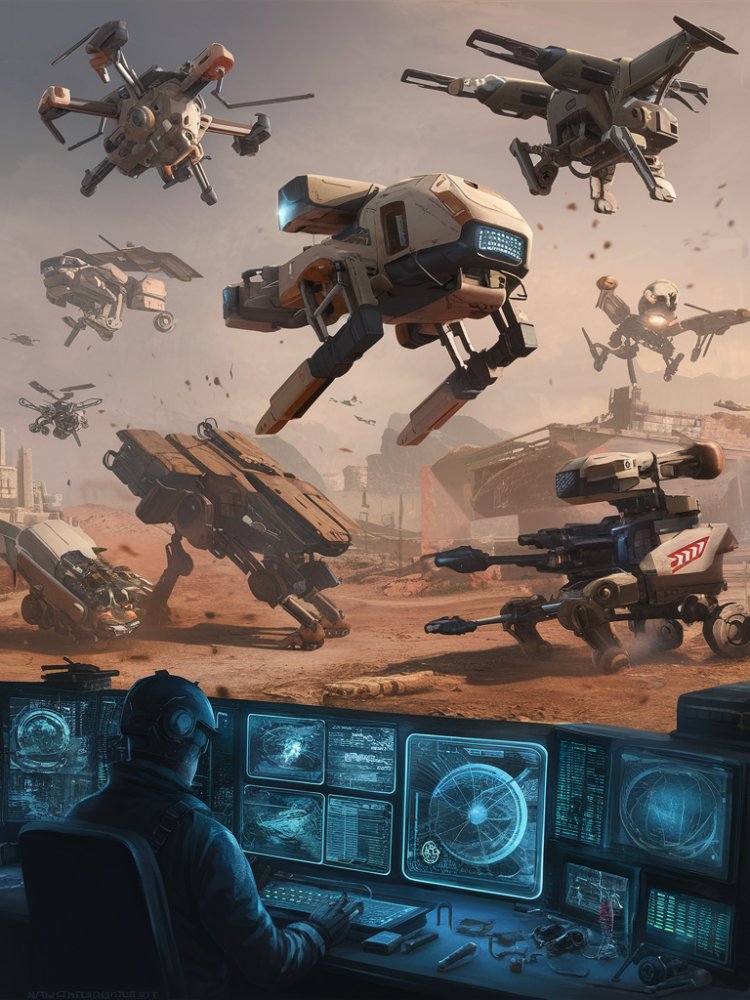
Now, ground robots — called Unmanned Ground Vehicles, or UGVs — are filling the gap left by soldiers who can no longer safely advance. These range from supply bots carrying ammunition to the front, to armed machines that can engage enemy troops. One manufacturer alone produced over 2,000 of these robots for Ukraine in 2025, and expects to supply around 40,000 in 2026. Uncrewed boats have also crippled Russia's navy in the Black Sea. The message is clear: this is not a future technology. It is happening now, at scale.
Perhaps most strikingly, there have been reports of Ukrainian and Russian robots clashing with each other — with no humans present on either side. Robot-vs-robot combat, once the stuff of science fiction, is already a reality.
What Comes Next?
Military leaders are already imagining the next phase: swarms. Dozens — or hundreds — of drones attacking simultaneously from the air, the ground, and the sea, all guided by artificial intelligence (AI). Former Ukrainian commander-in-chief Valerii Zaluzhnyi has described this vision openly: cheaper, smarter machines coordinating attacks from every direction at once.
Further ahead, robotics manufacturers are working on humanoid combat robots — machines that walk upright and could one day act like human soldiers. One company director said, matter-of-factly: "It won't be science fiction anymore." Given how quickly things have changed in just the last two years, it is hard to argue with him.
The Ethical Questions We Cannot Ignore
The speed of this technological shift is outpacing the moral and legal frameworks designed to govern warfare. Here are the hard questions we must be asking:
Who is responsible when a robot kills the wrong person? Under the laws of war, soldiers are accountable for their actions. But if a machine makes a lethal decision — even a flawed one — who faces consequences? The programmer? The military commander who deployed it? The manufacturer? Currently, there are no clear answers.
Can a machine tell the difference between a soldier and a civilian? Human soldiers are trained — imperfectly, but meaningfully — to make moral judgments in the chaos of battle. A drone guided purely by AI cannot feel compassion, hesitate out of doubt, or read the human context of a situation. The risk of civilian deaths rises significantly when machines make targeting decisions.
Does removing human risk make war too easy to start? One of the grim deterrents to war has always been the human cost — the grief of losing soldiers, the political backlash of body bags coming home. If wars can be fought with machines, with no human lives at immediate risk on one side, does that lower the threshold for going to war in the first place?
What happens when robot war escalates faster than humans can respond? When two autonomous systems clash — as is reportedly already happening in Ukraine — they can react in milliseconds. Humans simply cannot keep up. A skirmish between robots could escalate into a full conflict before any human commander has had time to intervene or de-escalate.
Who gets to have these weapons? Advanced military robots are becoming cheaper and more accessible. Nations, non-state groups, and even well-funded criminal organizations could eventually field autonomous weapons. Without international agreements — comparable to those governing chemical or nuclear weapons — there is no limit on who can deploy killer robots, or how.
A Fragile Line: Keeping Humans in the Loop
For now, most military robots still require a human operator to authorize any act of lethal force. Ukraine's armed ground robots, for example, are designed so that a person makes every firing decision — not the machine. This principle — known as keeping a "human in the loop" — is considered a critical safeguard by ethicists and military lawyers alike.
But this line is under pressure. As AI systems become more capable, the temptation to let machines make faster, fully autonomous decisions will grow. Some systems are already being designed to travel to a location, engage targets, and return to base — all without real-time human control. Once that line is crossed widely, rolling it back will be extraordinarily difficult.
Conclusion: Technology Moves Faster Than Wisdom
The age of robot warfare is not coming — it is here. The battlefield of Ukraine is a live testing ground for technologies that will shape how all future wars are fought. The machines themselves are impressive, even awe-inspiring in their capabilities. But machines do not have consciences. They do not mourn the dead. They do not weigh the moral cost of their actions.
That burden falls on us. The most important battles of the robot war era may not be fought on a battlefield at all. They will be fought in the halls of international law, in ethics committees, and in the choices societies make about what kind of warfare — and what kind of world — they are willing to accept.
Suggested Reading
For those who wish to explore these topics further, the following books and resources offer valuable perspectives:
Wired for War — P.W. Singer (2009) A groundbreaking and very readable examination of how robots and remote-controlled weapons are transforming the nature of combat, written for a general audience.
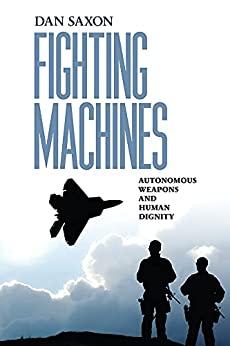
Army of None: Autonomous Weapons and the Future of War — Paul Scharre (2018) A thorough and balanced look at lethal autonomous weapons by a former Army Ranger and policy expert — highly accessible and widely regarded as the definitive book on the subject.
The Drone Age: How Drone Technology Will Change War and Peace — Michael J. Boyle (2020) Examines how drones are reshaping conflict, intelligence, and international relations around the world.
Human Compatible: Artificial Intelligence and the Problem of Control — Stuart Russell (2019) Written by a leading AI researcher, this book explores the broader challenge of keeping advanced AI systems aligned with human values — essential context for understanding autonomous weapons.
Drone Wars UK (dronewars.net) — Online Resource An independent organization that investigates and reports on the development and use of armed drones and autonomous weapons — a useful source of ongoing news and analysis.
Campaign to Stop Killer Robots (stopkillerrobots.org) — Online Resource A coalition of NGOs calling for a ban on fully autonomous weapons. A good starting point for understanding the international advocacy landscape.