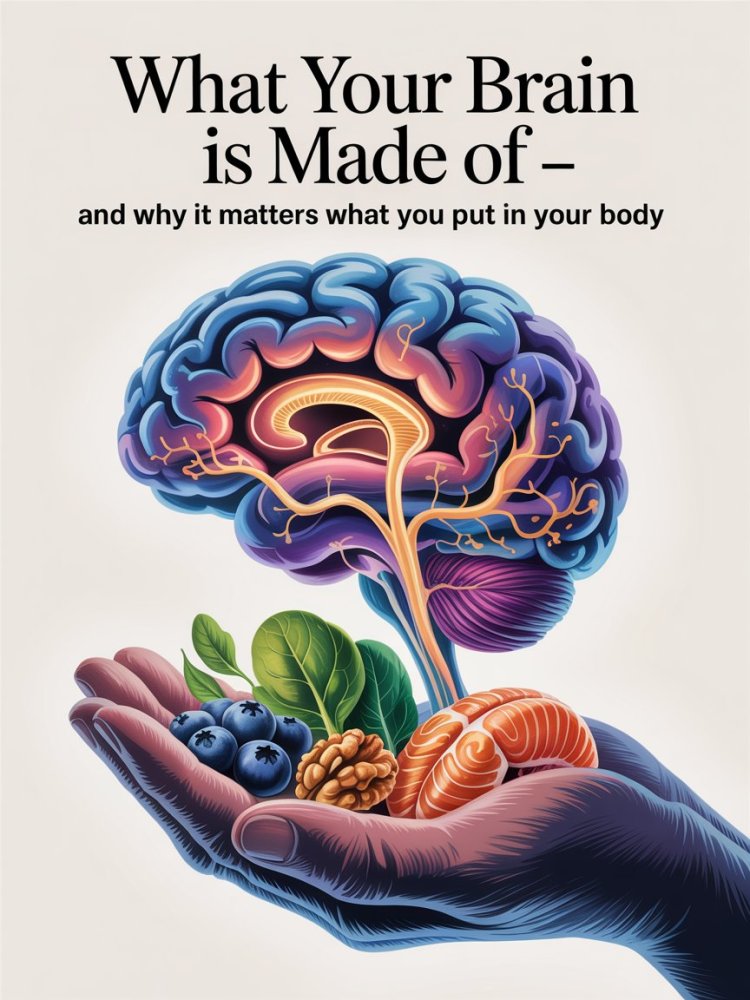
What Your Brain Is Made Of — And Why It Matters What You Put in Your Body
Cholesterol is the brain's essential building block. When we engineer it out of our diets or chemically suppress it, are we doing ourselves more harm than good?
A lay-person's guide to an ongoing scientific and ethical conversation
Here is something most doctors won't say out loud at your annual checkup: your brain desperately needs cholesterol. About 25% of all the cholesterol in your body lives in your brain, and cholesterol makes up a large portion of its dry weight. Every neuron — every single nerve cell firing as you read this sentence — is wrapped in a protective sheath called myelin, which is largely made of cholesterol. Synapses, the tiny bridges across which your thoughts and memories travel, require cholesterol to form and function properly. Without it, your brain quite literally cannot communicate with itself.
This is not a fringe idea. It is well-established neuroscience. And yet, for decades, we have waged an aggressive cultural and medical war against cholesterol — removing it from our diets, replacing natural fats with synthetic alternatives, and handing out cholesterol-blocking drugs to tens of millions of people. The ethical question worth asking plainly is: did we think that through?
The rise of synthetic fats: what margarine actually is
When saturated fats were vilified in the mid-20th century, the food industry offered margarine as the "heart-healthy" alternative. Margarine is made through a process called hydrogenation — pumping hydrogen gas through vegetable oil to make it solid at room temperature. The result is a product that looks and spreads like butter, but at the molecular level contains trans fats and industrially altered lipids that have no natural counterpart in the human body.
The human body, including the brain, works with natural fats: butter, lard, tallow, olive oil, coconut oil. It was never designed to process partially hydrogenated industrial oils. When synthetic fats enter circulation, the brain may attempt to use them as building materials — potentially incorporating them into cell membranes and myelin sheaths in place of the natural cholesterol and saturated fats those structures are supposed to be made from. Think of it like trying to build a house with counterfeit bricks: the structure may go up, but its integrity is compromised.
"The human brain is a fat organ. Over 60% of its dry weight is fat — and cholesterol is among the most critical of those fats. Any substance that displaces, mimics, or suppresses that fat is, at minimum, deserving of serious scrutiny."
Statins and the brain: a conversation medicine is still having
Statins are among the most widely prescribed drugs on earth. They work by blocking an enzyme the body uses to produce cholesterol in the liver. For people with certain cardiovascular risk factors, they can be genuinely life-saving. But cholesterol production does not only happen in the liver — the brain synthesizes its own cholesterol, almost entirely independently, because the blood-brain barrier prevents most blood cholesterol from entering the brain. The brain has to make what it needs, locally.
Some statins, particularly the fat-soluble varieties like simvastatin and lovastatin, are capable of crossing the blood-brain barrier. A growing body of research has explored links between long-term statin use and memory problems, cognitive decline, and mood disorders. The FDA updated statin labels in 2012 to include warnings about potential memory loss and confusion. Some researchers have also examined whether reduced brain cholesterol synthesis may impair the formation of new synapses — a process critical to learning and memory.
To be clear: this is an active area of scientific debate, not settled fact. Many studies find no significant cognitive harm. But therein lies the ethical tension. When we prescribe a drug that crosses into the most complex structure in the known universe and interferes with one of its primary building materials, the burden of proof for safety should be extraordinarily high — and the conversation with patients should be thorough and honest.
The ethical dimension: informed consent and dietary guidance
The ethical concern here is not simply about which molecule is harmful. It is about how public health recommendations are formed, communicated, and revised — and how long it can take for the system to correct course when the original guidance was wrong.
The campaign against dietary fat and cholesterol that began in the 1960s and 1970s led to a wholesale restructuring of the Western diet. Butter became a villain. Eggs became suspect. Processed vegetable oils flooded the food supply. Only decades later did the scientific community begin walking back many of these claims — acknowledging that dietary cholesterol has far less impact on blood cholesterol than once believed, and that trans fats from hydrogenated oils were, in fact, demonstrably harmful.
Millions of people made significant lifestyle changes, and were prescribed significant medications, on the basis of guidance that was at best incomplete and at worst incorrect. That is a serious ethical matter — not one of individual bad actors, but of systemic overconfidence and the downstream human cost of being wrong at scale.
None of this means cholesterol is harmless in all contexts, or that every statin prescription is unjustified. Medicine is nuanced, and individual risk profiles vary enormously. But it does mean that patients deserve honest, complete conversations about what their brains are made of, how the substances they consume interact with that biology, and what the genuine uncertainties are. That is what informed consent looks like.
"We lowered cholesterol. We changed the fats. We restructured the food supply. The one thing we perhaps did not do carefully enough — was ask what all of that would do to the three-pound organ that runs everything."
What you can do
Engage your doctor with specific questions: Is my statin fat-soluble or water-soluble? What are the cognitive risk considerations for my age and profile? Consider speaking with a registered dietitian who is up to date on current lipid research. And be thoughtful about synthetic fat consumption — the science on natural fats has shifted considerably, and whole-food sources of fat are generally preferable to industrially processed alternatives. Your brain is worth the conversation.
Suggested Reading
- Ravnskov, U. Fat and Cholesterol Are Good for You (2009) — A physician-led challenge to conventional lipid theory, drawing on decades of peer-reviewed literature.
- Perlmutter, D. Grain Brain: The Surprising Truth About Wheat, Carbs, and Sugar — Your Brain's Silent Killers (2013) — A neurologist's examination of how diet affects brain health, with a focus on fat and cholesterol.
- Teicholz, N. The Big Fat Surprise: Why Butter, Meat and Cheese Belong in a Healthy Diet (2014) — A deeply researched investigative account of how dietary fat science went wrong.
- Graveline, D. Lipitor: Thief of Memory (2004) — A former NASA astronaut and physician details his own cognitive decline on statins and reviews the clinical literature.
- Masterjohn, C. "Cholesterol and the Brain" — Weston A. Price Foundation (available at westonaprice.org) — A well-cited overview of cholesterol's essential neurological roles.
- Sinatra, S. & Bowden, J. The Great Cholesterol Myth (2012) — Two cardiologists re-examine the evidence linking cholesterol to heart disease and cognitive health.
This article is intended for general informational and ethical discussion purposes only. It does not constitute medical advice. Always consult a qualified healthcare provider before making changes to your medication or diet.